Rogue Core Reclaimers for DRG Players: Which Class Maps to Yours?
A Deep Rock Galactic player guide to Rogue Core Reclaimers: how Gunner, Scout, Driller, and Engineer map to Falconer, Guardian, Spotter, Slicer, and Retcon, with honest gaps and no forced one-to-one match.
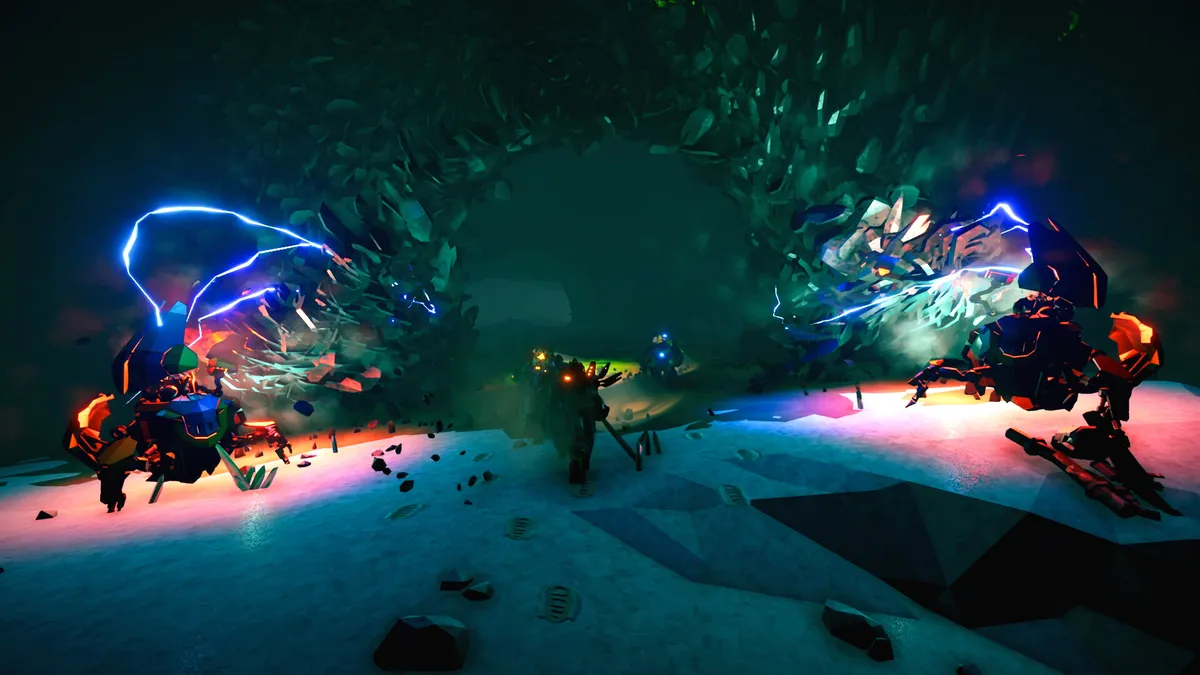
Combat Summary
- Deep Rock Galactic has four dwarven Classes: Gunner, Scout, Driller, and Engineer. Rogue Core has five Reclaimers: Falconer, Guardian, Spotter, Slicer, and Retcon. There is no clean one-to-one match between the two rosters, and any guide that pretends otherwise is misleading you.
- The closest temperament matches are Gunner to Guardian, as a frontline anchor who holds ground while the team works, and Scout to Spotter, as the eyes of the team who finds targets and paths before the fight starts. Driller and Engineer players face the biggest gaps: terrain reshaping has no counterpart in Rogue Core, and turrets and area control have no direct counterpart either.
- If you love Deep Rock Galactic for its digging, its building, or its slow, methodical cave control, Rogue Core will feel different in ways that matter. Read the honest conclusion near the end before you buy, because it names the players who should wait.
Why there is no one-to-one map
Deep Rock Galactic classes are built around jobs in a cave: one dwarf digs, one lights and scouts, one holds firepower, one builds defenses. Rogue Core Reclaimers are built around roles in a fast, wave-based fight against a rogue machine swarm. The games share a universe, a tone, and a developer, but they do not share a class design language.
That difference shows up immediately in team play. A Deep Rock Galactic team splits up to cover a cave: the Driller carves a shortcut while the Engineer builds a defensive line and the Scout runs ahead. A Rogue Core team stays closer together, because waves stack, Gatekeepers counterattack, and a separated player is a dead player. A class that made sense as a lone cave worker does not automatically make sense as a wave fighter, and Rogue Core does not try to force it.
So use this guide as a temperament map, not a conversion chart. Ask what you enjoy doing in a mission, not what your dwarf is called, and pick the Reclaimer that lets you do the nearest version of that job. Where no near version exists, this guide says so plainly instead of inventing one.
Gunner players: start with Guardian
Gunner players who love being the anchor should start with Guardian. The Guardian is the frontline presence of a Rogue Core team, the Reclaimer who holds ground, absorbs pressure, and lets teammates do their work behind a stable line. The feeling is familiar: you are the reason the team can stand its ground, and when the fight moves, you move with it rather than retreating behind it.
The gap is in the toolset. A Gunner brings heavy weapons and a shield for a defined defensive job. A Guardian brings a frontline kit for a faster, more mobile fight, where holding ground means holding it for a window, not for a whole cave section. Do not expect to plant yourself in one spot and win the mission from there. Expect to hold, push, reposition, and hold again as waves arrive.
If you played Gunner because you like being needed in a crisis, Guardian will suit you. If you played Gunner only for one specific weapon fantasy, check the Guardian guide and frontline builds before you commit, because the fantasy is the role, not a copied loadout.
Scout players: start with Spotter
Scout players who love information should start with Spotter. The Spotter is the reconnaissance Reclaimer, the one who finds targets, marks threats, and gives the team a picture of the fight before it closes in. The rhythm will feel familiar: move, look, report, and let the team act on what you found.
The gap is in what scouting buys you. In Deep Rock Galactic, a Scout finds a cave path, a mineral vein, or a hidden room, and the reward lasts for the whole mission. In Rogue Core, information buys you a window: a better opening, a safer angle, or a priority target removed before it becomes a problem. The fight moves too fast for scouting to be a separate phase. It is part of the combat loop, not a prelude to it.
Scout players who enjoy mobility and awareness will feel at home with Spotter. Scout players who mainly enjoyed solo exploration of quiet caves will find Rogue Core louder and less lonely, and that is a taste difference, not a skill problem. For the full build picture, see the Spotter guide and builds.
Driller players: the honest gap
Driller players face the largest gap in this guide, and it deserves a direct statement: terrain reshaping has no counterpart in Rogue Core. There is no Reclaimer who carves tunnels, reshapes a cave, or opens a new route through rock as a core job. If digging and reshaping terrain is the main reason you love Deep Rock Galactic, Rogue Core does not replace that feeling with anything equivalent.
What Driller players can still enjoy is the temperament behind the class: the willingness to do the unglamorous job, to open a path for the team in a different sense, and to stay calm when the plan breaks. Slicer suits Driller players who like aggressive, close work and do not mind being the one who goes in first. Guardian suits Driller players who like being the reliable backbone of a team. Neither one lets you dig, and neither one should be sold as a Driller replacement.
Try Rogue Core as a different game that shares your taste for teamwork, not as a new home for your Driller. If the missing digging feels like a deal-breaker after a few runs, trust that feeling. It is telling you something true about what you value in a game.
Engineer players: the honest gap
Engineer players face the second large gap: turrets and area control have no direct counterpart in Rogue Core. There is no Reclaimer whose core job is to build a turret line, set up a defensive zone, and let machines do the holding while the team works elsewhere. Rogue Core fights are too mobile, and its waves too stacked, for a static build to be the answer.
What Engineer players can still enjoy is the support temperament: watching the team, covering a weakness, and making everyone else better. Falconer suits Engineer players who like ranged support and team-wide value from a distance. Guardian suits Engineer players who like holding a line themselves rather than building something to hold it for them. Spotter suits Engineer players who like giving the team information it can act on. None of these is a turret, and the guide will not pretend otherwise.
If your favorite Deep Rock Galactic moments are the quiet minutes building a perfect defensive setup before a swarm, Rogue Core will not give you those minutes back. Its best moments are faster, louder, and more reactive. That can still be fun, but it is a different kind of fun, and you should know that before you pay.
Falconer, Slicer, and Retcon in plain terms
The three Reclaimers not covered above round out the roster, and each one suits a different Deep Rock Galactic temperament. Falconer is the ranged, team-support Reclaimer, strong in co-op and a natural home for players who like to contribute from distance while keeping the team alive and dangerous. Slicer is the close-range execution Reclaimer, the solo standout, built for players who want to delete a priority target fast and leave before the next wave lands. Retcon is the unusual one, ranked by community consensus as A-tier for solo play and C-tier for co-op, a Reclaimer that rewards careful timing and discipline more than raw aggression.
For the full ranking context, see the class tier list for solo and co-op play, the Falconer guide and co-op builds, the Slicer guide and best builds for solo play, and the Retcon guide and solo tactics. For how a full team fits together, see the co-op team compositions and squad builds.
An honest conclusion: who should not buy, and who should wait
This section is the part of the guide that matters most, and it is deliberately blunt. Do not buy Rogue Core right now if you want a Deep Rock Galactic sequel with digging, building, and slow cave exploration. Rogue Core is a different game in the same universe, and it will not scratch that itch no matter how much you like the setting.
Do not buy it right now if you mainly play solo and want a relaxed, low-pressure experience. Rogue Core at higher difficulties is demanding, its waves stack, and its boss fights punish hesitation. Solo play is viable, and some Reclaimers shine alone, but the game is not a calm mining session with occasional combat. It is combat with mining nowhere in sight.
Wait, rather than buying today, if you are on the fence about the current state of the game. Rogue Core currently holds a Mixed reception on Steam, which means a meaningful share of players have not enjoyed it as it stands. A new major update is targeted for late October or early November 2026, a target rather than a locked date, and waiting to see what that update changes is a reasonable, honest choice. Waiting costs you nothing, and it lets you judge the game after its next big step instead of before it.
Buy it, or try it, if you want fast, wave-based co-op combat in the Deep Rock Galactic universe, if you enjoy learning a new class roster on its own terms, and if you have friends to play with. The game is at its best with a team that communicates, and a Deep Rock Galactic group that moves over together will have a head start on teamwork even if every class feels new.
For the fuller buy-or-wait case, including price, content volume, and what the current game does well and poorly, see the Rogue Core versus Deep Rock Galactic guide on whether DRG players should buy.
Verification note
Class rosters in this guide are official: Deep Rock Galactic has Gunner, Scout, Driller, and Engineer, and Rogue Core has Falconer, Guardian, Spotter, Slicer, and Retcon. The mapping advice, temperament matches, and honest gaps are community-tested guidance: no one-to-one class conversion exists, terrain reshaping has no Rogue Core counterpart, and turret-based area control has no direct counterpart. The Mixed Steam reception and the targeted late October or early November 2026 window for the next major update are stated as current status, not as promises.
Continue Reading
Don't deploy without all the intel. Check out this related file:
Deep Rock Galactic Rogue Core vs DRG: 7 Key Differences Explained →