Deep Rock Galactic Rogue Core vs DRG: 7 Key Differences Explained
Coming from Deep Rock Galactic? Here are the 7 biggest differences in Rogue Core — roguelite runs, five Reclaimers, Threat Levels, the Reaperworm timer — and what DRG skills still transfer.
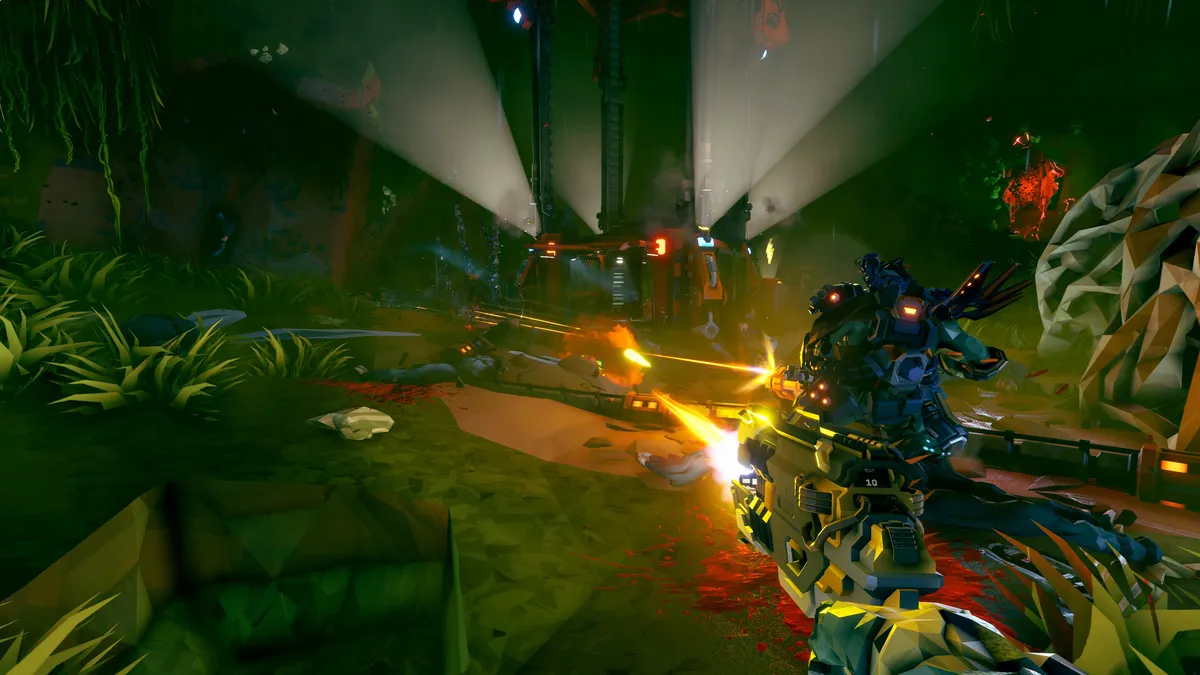
Combat Summary
The short answer for DRG veterans: Deep Rock Galactic: Rogue Core is a standalone roguelite spin-off, not DRG 2. You keep the dwarves, the co-op, and the Hoxxes attitude — but missions are now timed roguelite runs with randomized upgrades, five new Reclaimer classes replace the four DRG classes, difficulty comes from Threat Levels instead of Hazards, and a Reaperworm timer forces you to keep moving. Your DRG fundamentals (positioning, teamwork, target priority) transfer directly; your class mastery and build habits do not. Below are the 7 differences that actually change how you play, each marked as official fact or community-tested observation.
1. Roguelite Runs Replace Persistent Mission Structure
Official. The original Deep Rock Galactic is mission-based: you pick a class, load into a procedurally generated cave with your persistent unlocks and overclocks, complete the objective, and extract. Your dwarf grows steadily across hundreds of hours.
Rogue Core rebuilds this as a roguelite. Each dive is a run: you start with a baseline kit, draft randomized upgrades as you go, and build your power curve inside the mission. Death ends the run and its temporary build. Permanent progression exists between runs — players report account-level unlocks and meta progression — but the moment-to-moment game is about adapting to what the run gives you, not executing a pre-planned loadout.
What this means for DRG players: Your DRG habit of perfecting one loadout over dozens of missions works against you here. Rogue Core rewards flexibility — community testing shows the best players draft around what appears, not around a fixed plan.
2. Five Reclaimers Instead of Four Classes
Official. DRG has four iconic classes: Gunner, Driller, Engineer, and Scout, each with fixed weapons, traversal tools, and a deeply drilled role.
Rogue Core launches with five Reclaimers: Slicer, Guardian, Retcon, Spotter, and Falconer. These are not reskins of the DRG classes — they are new kits built for the roguelite format, and community testing shows their value splits violently by game mode. Our Rogue Core class tier list breaks this down, but the headline is: the best solo Reclaimer (Slicer) is nearly the worst co-op pick, and the best co-op pick (Falconer) struggles alone.
| DRG Class | Closest Rogue Core Reclaimer | Key Difference |
|---|---|---|
| Gunner | Slicer | Slicer is solo-oriented burst damage; less team support than Gunner’s shield |
| Engineer | Guardian | Guardian holds ground like Engineer’s turrets do, but more mobile |
| Scout | Spotter | Both are information classes; Spotter is built for team play, not solo flares-and-grapple |
| Driller | Retcon | Retcon’s adaptability echoes Driller’s terrain-shaping versatility |
| — | Falconer | No DRG equivalent — pure team force-multiplier |
What this means for DRG players: Do not pick the Reclaimer that “looks like” your DRG main. Read the tier list for your mode first — role logic does not map 1:1.
3. Threat Levels Replace Hazard Levels
Official (Update 2). DRG scales difficulty with Hazard levels 1–5, layered on top of mission types and modifiers. Rogue Core uses five Threat Levels — and since Update 2, Depth is purely a content progression tree that does not affect difficulty at all.
Each Threat Level step raises enemy count, swarm frequency, enemy HP and movement speed, aggression and attack frequency, projectile speed, and overall damage (official). Threat Level 4 adds wave stacking, where stage waves can overlap — effectively a second difficulty dimension.
What this means for DRG players: In DRG you might pick Hazard 4 for loot and accept the pain. In Rogue Core, climbing Threat Levels before your builds are ready is the fastest way to waste runs. Our Threat Level 1–3 climb guide covers exactly when to move up: clear your current level with health to spare and a half-built synergistic loadout before climbing.
4. The Reaperworm Timer Forces Pace
Official (Update 1.2). DRG missions have no hard timer — you can mine every last vein of gold at your own pace, and many players do.
Rogue Core adds the Reaperworm clock: about 30 seconds after the first Reaperworms appear, additional worms spawn over time, with the spawn rate scaling by player count. This is a soft mission timer that punishes lingering. Community testing consistently shows new players lose more runs to greed — farming one more vein — than to any enemy.
What this means for DRG players: Your DRG instinct to fully clear every room is the single most dangerous habit to bring into Rogue Core. Plan your route so the objective is nearly done when the worms arrive, then move to the elevator. Check our beginner guide for the full first-runs checklist.
5. Expenite and the R.E.P.D. Replace DRG’s Economy
Official. DRG’s economy runs on mined minerals (gold, Bismuth, etc.) converted to credits between missions for permanent unlocks.
Rogue Core’s in-run economy is Expenite, spent at the R.E.P.D. station during the mission. Since Update 1, any Reclaimer can activate an upgrade once the team has enough Expenite, and all players receive it simultaneously regardless of location (official). There is no reason to hoard — spend it.
Community-tested: Enhancement upgrade pools are per-player with no shared deck, so your draft choices are yours alone even though R.E.P.D. purchases hit the whole team.
What this means for DRG players: DRG teaches you to save for big purchases. Rogue Core teaches the opposite — an unspent Expenite wallet is wasted power. In co-op, call out what you are buying so the team can plan around it.
6. Gatekeepers Fight Back With Counterattacks
Official (Update 1.2). DRG’s Dreadnoughts and other bosses are damage races with telegraphed attacks — learn the pattern, dodge, burn.
Rogue Core’s Gatekeepers (bosses) have counterattacks that reduce pressure on themselves and can temporarily block some or all of your attacks while pressuring your squad. The rookie mistake — straight from DRG muscle memory — is dumping your burst the moment the boss appears. Watch for the counterattack tell, bait it out, then punish the recovery window. Risk Vector spawns also assist bosses now, so assign someone to add duty.
What this means for DRG players: Your DRG boss instincts (burst on sight) will get punished. Rogue Core boss fights are closer to a fighting game: bait, punish, repeat.
7. Upgrade Drafting Replaces Loadout Building
Official (Update 1). In DRG, you build your loadout before the mission: weapons, overclocks, perks — all chosen in advance and fixed for the dive.
Rogue Core’s upgrade negotiation rework means when you pick an upgrade it is replaced with a new option, so every player gets equal choices. “Skip for Health” is gone — health upgrades now appear in the normal pool. Your build emerges from draft decisions made under pressure, and Update 2 added seven elemental Expenite upgrades (Spark-Booster, Grid-Shock, Weathering Blast, Icy Shrapnel, Icicle Strike, Concussive Shot, Frostbane) that reward status-effect synergies over raw damage stacking (community-tested).
What this means for DRG players: Stop theorycrafting the perfect build before launch. Start learning to read a draft: what is my build missing, what does the team need, and which upgrade fixes a weakness instead of just adding damage.
What Transfers From DRG
Not everything changes. Community consensus says these DRG skills carry over at full value:
- Positioning and kiting. Swarm behavior rhymes with DRG’s swarm events — if you could dance around a Bulk Detonator, you can handle Rogue Core’s hordes.
- Target priority. Kill the thing that kills your team first. Universal.
- Team communication. Co-op lives or dies on callouts in both games.
- Hoxxes attitude. Rock and Stone still applies. (Community-tested, extensively.)
How This Works in Rogue Core
If you are a DRG veteran reading this to decide whether Rogue Core is worth your time: it is a different game wearing a familiar uniform. The 30-second pitch is “DRG meets roguelite” — shorter, tenser missions where every run plays differently, wrapped in the co-op chaos you already know. Your game sense transfers; your habits need retraining. Start with our beginner guide’s 15 tips, pick your Reclaimer from the tier list for your mode, and respect the worm clock. The rest you will learn by dying — which, as any DRG player knows, is the traditional curriculum.
FAQ
Is Deep Rock Galactic: Rogue Core a sequel to Deep Rock Galactic? No. It is a standalone roguelite spin-off set in the same universe, developed by Ghost Ship Games. It is not DRG 2 and does not continue DRG’s story or progression — it is a separate game with its own systems, currently in Steam Early Access (official).
Do I need to own Deep Rock Galactic to play Rogue Core? No. Rogue Core is a fully standalone title on Steam (official). DRG experience helps — positioning, teamwork, and game sense transfer — but nothing carries over between the games and nothing is required.
Are the Reclaimers the same as DRG classes? No. The five Reclaimers (Slicer, Guardian, Retcon, Spotter, Falconer) are new kits, not reskins of Gunner, Driller, Engineer, and Scout. Their roles do not map 1:1 — read the community tier list for your game mode before picking a main (community-tested).
Is Rogue Core harder than DRG? Differently hard. DRG’s difficulty is about execution within a known loadout; Rogue Core’s is about adaptation — building power from randomized drafts under a mission timer. Players report the learning curve feels steeper because bad draft decisions compound, but the missions themselves are shorter (community-tested).
Can I play Rogue Core solo? Yes — 1–4 player co-op is supported including solo (official). But note the class tier list splits hard by mode: Slicer and Guardian are the community’s solo picks, while Falconer and Spotter are built for teams. Pick for your mode (community-tested).
Continue Reading
Don't deploy without all the intel. Check out this related file:
Rogue Core Solo Guide: How to Survive and Win Alone →