Rogue Core Trident vs Corrosive Sludge Pump: Best Shotgun
Trident vs Corrosive Sludge Pump: compare Rogue Core's two Update 1 shotguns on damage models, ammo economy, Threat Level scaling, and the verdict by playstyle.
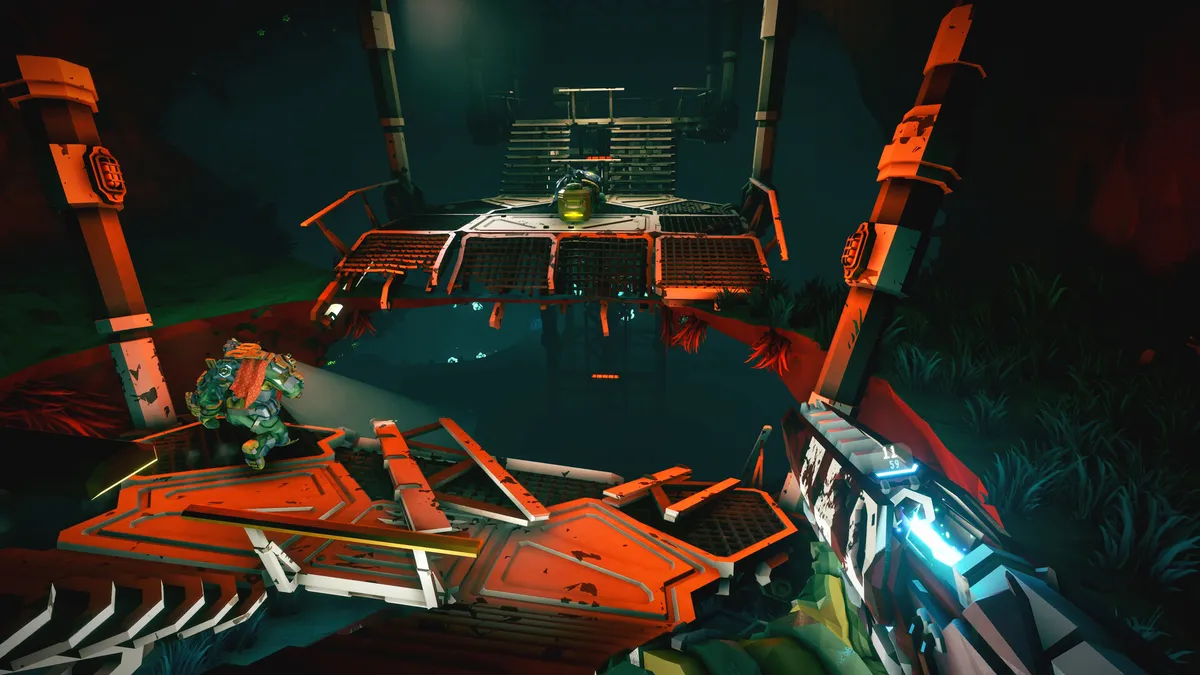
Combat Summary
- Official: The Trident and the Corrosive Sludge Pump both arrived in Update 1 (June 17, 2026). The Trident is an energy shotgun in the starting weapon pool; the Pump is a heavy weapon built around stacking corrosion damage over time.
- Community tested: The Trident wins burst exchanges — point-blank pulls delete priority targets in one or two shots, then you swap weapons while it recycles. The Pump wins sustained fights — corrosion ticks keep damaging enemies while you reposition, reload, or engage the next target.
- The short answer: Neither gun is strictly better. Pick the Trident for aggressive close-range play and single-target pressure; pick the Corrosive Sludge Pump for wave clear, objective defense, and sustained fights. If you only master one, master the Pump — Rogue Core throws volume at you, and corrosion scales into volume better than burst.
So which shotgun should you actually bring? It depends on what your run asks of you. A Threat Level 1 mission asks for room-clearing speed, and both guns clear rooms. A Threat Level 5 mission with stacked waves asks for damage that keeps working while you move, and only one of these guns does that. A Depth 3 Gatekeeper fight asks for burst inside short damage windows — only one does that well. This guide breaks down the damage models, the ammo math, how each gun behaves as Threat Levels rise, what to draft on each, and where each shines in solo and squad play — then gives a verdict by playstyle, not by hype.
Damage Models: Burst vs Corrosion
The two guns solve the same problem — killing things at close range — with opposite damage shapes.
Official: The Trident is a burst weapon: high damage per pull, wide spread, short effective range, and a slow cycle between shots. Its job is dropping a target fast, then swapping or repositioning while it recycles. The Sludge Pump is an attrition weapon: each hit applies corrosion, a stacking damage-over-time status, and reapplying it refreshes the duration. Its job is tagging everything once and letting the ticks finish the work.
These shapes create opposite skill checks: the Trident’s is range discipline — fire past its effective band and you waste the pull. The Pump’s is application discipline — miss your shots and you get neither direct damage nor corrosion. The Pump check fails less often with experience, which is one reason it feels stronger the longer you play.
Official: Since Update 2, damage-triggered boss invulnerability phases are gone — Gatekeepers now do short blocks or blockable attacks instead — and since Update 1.2 every Gatekeeper has counterattacks that can shut down your pressure. Community tested: Short damage windows favor burst. The Trident’s whole pull lands inside one window; the Pump’s corrosion keeps ticking through a block phase, but the block still eats your direct hits. Against a Depth 1 Gatekeeper the difference is marginal. Against a Depth 3 Gatekeeper on a high Threat Level, the Trident’s burst-window efficiency is a real edge.
In-game verified: Exact numbers for both guns live on their stat cards and in the Workbench, and balance patches move them. Treat any specific DPS figure in older guides — including this site’s early ones — as suspect and check in-game.
Ammo Economy: What Each Gun Really Costs
Community tested: Both guns are hungry, but in different ways. The Trident burns ammo fast because every pull is a full shell and every missed pull is wasted money. The Pump is a heavy weapon, and heavy weapons have the worst ammo economy in the game — sustained corrosion output means sustained ammo consumption, and without ammo investment a Pump build ends early and awkwardly.
Official: The Early Access Living Roadmap lists ammo economy tuning as still open — it was one of Update 1’s three headline complaints, alongside the mission timer and shared upgrades, and it is the one that only got partially tuned. Do not plan your build around the hope that a patch fixes shotgun ammo.
The practical takeaway is the same on both guns: your secondary must be ammo-cheap or ability-based. If the shotgun eats your entire pickup budget, you need a fallback that costs nothing to run. In squads, coordinate — two heavy-weapon players starve each other, and two shotgun users split the same pickup pool. Call your ammo lane early.
Threat Level Scaling: Where the Gap Opens
Official: Update 2 replaced the old difficulty model with five Threat Levels: enemy count, swarm frequency, enemy HP and movement, aggression and attack frequency, projectile speed, and overall damage all scale up. Depth no longer affects difficulty — it is purely a content progression tree now. On Threat Levels 4–5, stage waves can stack.
Community tested: This is where the two shotguns diverge. The Trident’s burst is binary — at low Threat Levels it one-pulls most things and feels unbeatable; at TL4–5, tanky elites survive the pull, and the gun’s slow cycle becomes a standing-still tax while stacked waves close in. The stock Trident falls off hard at TL4–5 unless the draft fed it damage upgrades and pellet-tightening.
The Pump’s corrosion is non-binary. Ticks do not care how much HP an enemy has — they scale with your corrosion investment, and corrosion duration matters as much as corrosion damage, which means more total ticks per application. Community tested: Full-corrosion builds scale into waves better than almost any other weapon identity in the game, which is exactly the regime TL4–5 stacked waves live in.
Speculation: If the Update 3 experimental change — enemies dropping Expenite by default — ships as a core feature, sustained-fire builds like the Pump would benefit disproportionately: they stay in the fight longer and vacuum more drops. Treat this as speculation until the patch notes land.
Upgrade Philosophy: What to Draft on Each Gun
Rogue Core’s draft system offers randomized options each run, so think in priority orders, not shopping lists. Official: Update 1’s Upgrade Negotiation rework means a picked upgrade is replaced with a new option (everyone gets equal choices), all drafts share the same rarity, and R.E.P.D. changes mean any Reclaimer can activate an upgrade once there is enough Expenite — all players receive it simultaneously, wherever they are.
Trident priority (community tested): Damage first — a shotgun that does not drop targets in one or two pulls wastes its identity. Then ammo capacity and reserve. Then reload speed, because the Trident punishes downtime hardest. Then spread and pellet behavior — tighter spread extends the lethal band. For the full TL4–5 treatment with Overclock styles and Expenite upgrades like Spark-Booster or Grid-Shock, see our Trident TL4–5 build guide. For the fundamentals, the Trident starter guide covers the basics.
Sludge Pump priority (community tested): Corrosion strength and duration first — build for corrosion uptime, not raw per-hit damage. Then ammo capacity and efficiency. Then reload and handling, because the Pump’s downtime is when corroded enemies catch up. Then on-hit and on-status effects, which multiply in value because corrosion generates hits constantly. The one exception: a hybrid-impact variant that mixes direct damage with corrosion, which only pulls ahead when your squad already has strong wave clear and needs help on single targets. Details are in the Sludge Pump build guide.
Community tested: Never chase per-hit damage on the Pump or sustained-DPS dreams on the Trident — build each gun toward its identity.
Solo vs Squad: Where Each Shotgun Shines
Community tested: In solo play you are your own wave clear, burst, and ammo plan — which makes the Pump the safer solo pick for most players. Corrosion keeps working while you kite, and you never depend on a partner to finish what your burst started. Trident solo works, but it demands cleaner positioning and a mobility-leaning Reclaimer, because there is no teammate to cover your reload.
In squads, the calculus flips toward roles. The Pump is a mid-line weapon: close enough to apply corrosion, far enough to avoid the hits your zones punish. It pairs with crowd-control tools that hold enemies inside corrosion zones and with a burst partner — ideally a Trident user — who finishes corroded targets fast. The Trident in a squad becomes the finisher: the Pump user tags everything, you delete the tagged elites in one pull, and the corrosion ticks clean up whatever your burst missed.
Community tier discussion (gamebrief.net, July 2026) ranks solo Slicer > Guardian > Retcon > Spotter > Falconer and co-op Falconer > Spotter > Guardian > Slicer > Retcon. Enhancement pools are per-player, so your shotgun choice does not lock your teammate’s build — coordinate roles, not loadouts.
One squad rule is ironclad either way: do not stack ammo lanes. Two heavy-weapon players starve each other, and two Trident users split one pickup pool. One shotgun per squad, with the other players on ammo-cheap or ability-based secondaries, keeps everyone firing through the run.
The Verdict: Pick by Playstyle
| Trident | Corrosive Sludge Pump | |
|---|---|---|
| Damage shape | Burst: everything lands at once | Attrition: ticks finish the work |
| Best range | Point-blank | Close to mid |
| Ammo profile | Fast burn, expensive misses | Worst-in-class sustained drain |
| TL4–5 scaling | Falls off unless damage kept pace | Full corrosion scales into waves |
| Boss pressure | Strong in short damage windows | Ticks continue through blocks |
| Solo | Demands clean positioning | Safer, kites while ticks land |
| Squad role | Burst finisher | Mid-line corroder |
Pick the Trident if: you play aggressively, you like dictating engagements at close range, your squad needs a finisher for elites and Gatekeepers, or your run keeps offering you damage upgrades. It is the better gun when the job is “kill this specific thing right now.”
Pick the Corrosive Sludge Pump if: you defend objectives, you kite, your squad needs sustained damage against waves, or you are running solo on high Threat Levels. It is the better gun when the job is “kill everything coming at us for the next two minutes.”
Community tested: If you force a single winner across all content, the Pump edges it — volume is the game’s default pressure, and corrosion is the damage shape built for volume. But the best squads run one of each: the Pump melts the wave, the Trident deletes what the wave was protecting, and neither player fights the other for ammo lanes.
Verification status: weapon identities and Update 1 placement are official (Steam patch notes, June 17, 2026); upgrade priorities, matchup conclusions, and tier discussion are community-tested strategy, not official guidance.
Continue Reading
Don't deploy without all the intel. Check out this related file:
Rogue Core Trident TL4-5 Build: Best Overclocks and Loadouts →